The Muddy Military Disaster That Built America's Highway Dreams
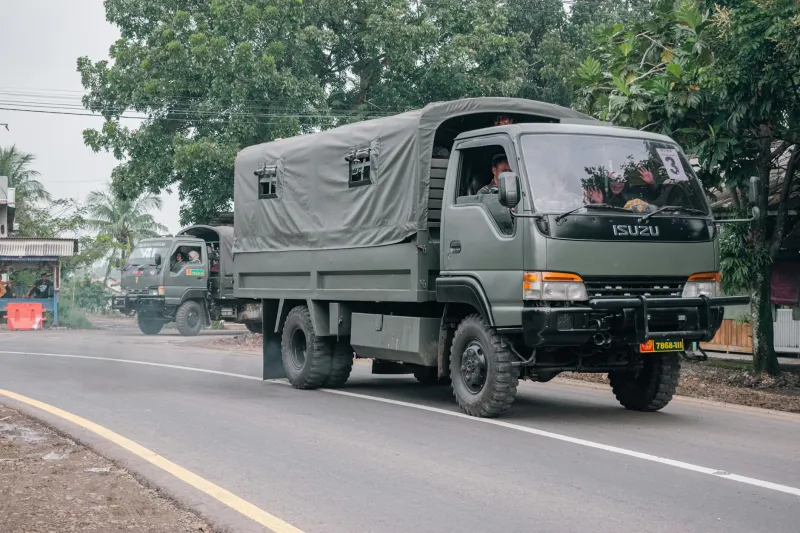
The Convoy That Couldn't
In the summer of 1919, the U.S. Army launched what seemed like a simple publicity stunt: drive a military convoy from Washington, D.C. to San Francisco to demonstrate American road readiness and promote military vehicles to civilian buyers. What could go wrong?
Everything, as it turned out.
The Motor Transport Corps expedition, featuring 81 vehicles and 280 soldiers, immediately discovered that America's "roads" were more like suggestions. The convoy averaged six miles per hour—slower than a brisk walk. Trucks sank axle-deep in mud. Bridges collapsed under military weight. In Nebraska, they spent an entire day traveling 17 miles.
Among the miserable, mud-caked officers enduring this 62-day ordeal was a young lieutenant colonel named Dwight D. Eisenhower. He would remember every pothole.
When Reality Met Ambition
The 1919 convoy wasn't just slow—it was revelatory. America had spent the previous century building railroads while largely ignoring roads. Outside major cities, "highways" were often little more than wagon trails that turned into impassable swamps when it rained. The Lincoln Highway, supposedly the country's first transcontinental auto route, existed more as a concept than an actual road.
Eisenhower kept a detailed diary of the journey's disasters. Vehicles broke through wooden bridges. Entire sections of the convoy got lost when roads simply disappeared. In Utah, they encountered sand dunes where maps promised highways. The expedition that was supposed to showcase American infrastructure instead revealed how embarrassingly unprepared the country was for automobile travel.
What struck the young officer wasn't just the poor condition of existing roads—it was their complete inadequacy for any kind of national defense or economic development. How could America function as a modern nation when it took over two months to drive from coast to coast?
The German Inspiration
Fast-forward to World War II. General Eisenhower found himself in Germany, witnessing Hitler's autobahn system—the world's first network of limited-access highways designed specifically for high-speed automobile travel. The strategic implications were obvious: good roads meant rapid troop movement, efficient supply lines, and economic integration.
The autobahn wasn't just impressive engineering—it was a national security advantage. Eisenhower realized that America's road system was still essentially what he'd struggled through in 1919, just with slightly better surfaces. In a modern war, that could be catastrophic.
But the real revelation wasn't military—it was cultural. The autobahn had transformed how Germans lived and worked, connecting rural areas to cities, enabling commuter suburbs, and creating entirely new patterns of commerce and recreation. Roads weren't just transportation infrastructure—they were social architecture.
The Cold War Highway Revolution
When Eisenhower became president in 1953, that muddy 1919 journey was still fresh in his memory. The Cold War provided the perfect justification for what he'd been thinking about for decades: America needed to be completely rewired for automobile travel.
The Federal-Aid Highway Act of 1956 wasn't sold as a quality-of-life improvement—it was pitched as national defense. The official name was the National Interstate and Defense Highways Act, emphasizing military necessity over civilian convenience. Congress approved $25 billion (over $270 billion in today's money) to build 41,000 miles of limited-access highways connecting every major American city.
What Eisenhower didn't anticipate was how profoundly this infrastructure would reshape American culture. The Interstate Highway System didn't just make travel faster—it made entirely new kinds of travel possible.
The Accidental Cultural Revolution
Before the interstates, long-distance automobile travel was an adventure requiring careful planning, local knowledge, and considerable patience. After the interstates, it became routine. Families could drive from Chicago to Florida for vacation. College students could road trip across the country. Businesses could expand nationally with confidence in reliable transportation.
The American road trip—that uniquely democratic form of exploration where anyone with a car could discover the country at their own pace—became possible only because a young Army officer had spent 62 miserable days stuck in the mud in 1919.
Suburban sprawl, the decline of passenger rail, the rise of chain restaurants and motels, the growth of Sun Belt cities, the transformation of American retail around automobile access—all of these massive cultural shifts trace back to Eisenhower's memory of that failed convoy crawling across an unpaved continent.
The Road Forward
Today, Americans drive over 3 trillion miles annually on roads that exist because a military publicity stunt went hilariously wrong in 1919. The Interstate Highway System, born from one man's frustration with American road conditions, became the infrastructure foundation for modern American life.
The next time you cruise effortlessly down an interstate at 70 mph, remember: you're traveling on roads that exist because a young Army officer once spent two months learning exactly how terrible American roads could be. Sometimes the most transformative innovations begin with the most basic recognition that the current system simply doesn't work.
Eisenhower's highway revolution proves that the most far-reaching changes often start with someone who's personally experienced just how broken things really are.