The Botanist Who Ran Out of Paper and Accidentally Organized the World
The Botanist Who Ran Out of Paper and Accidentally Organized the World
Before the cloud. Before the spreadsheet. Before the filing cabinet, the three-ring binder, and the color-coded sticky note — there was the index card. A small rectangle of stiff paper, lined on one side, blank on the other, designed to hold a single piece of information that could be sorted, shuffled, rearranged, and retrieved.
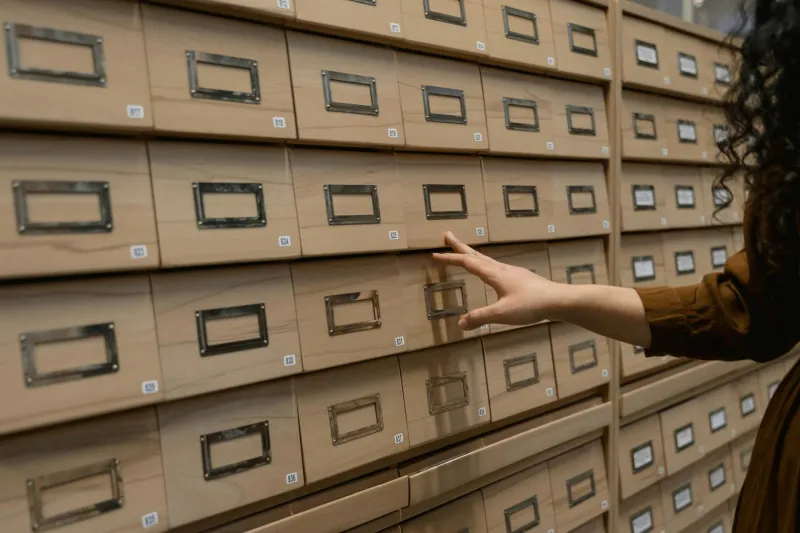
For most of the 20th century, the index card was everywhere in American life. Libraries built entire rooms around them. Office workers filled metal drawers with them. Writers, scientists, lawyers, and academics organized their entire professional lives through carefully maintained card systems. Recipe boxes sat on kitchen counters in homes from Maine to California, stuffed with handwritten 3x5 cards that held the family's most important culinary knowledge.
And almost nobody knows where the index card came from.
The answer starts in 18th-century Sweden, with a botanist who had too many plants and not enough paper.
Carl Linnaeus and the Problem of Everything
Carl Linnaeus is one of the most consequential scientists in history, though most Americans only vaguely remember his name from a high school biology class. He was a Swedish naturalist born in 1707, and his great obsession was order. Specifically, he wanted to bring order to the overwhelming, chaotic, constantly expanding catalog of the natural world.
In the 18th century, European explorers and naturalists were returning from voyages around the globe with specimens, drawings, and descriptions of thousands of species that had never been formally documented. The problem wasn't the lack of information — it was the abundance of it. How do you organize thousands of plants, animals, and minerals in a way that allows you to find anything, update your records when new information arrives, and share your system with other scientists?
Books were one answer, but books were static. Once printed, they couldn't be reorganized. If you discovered a new species that belonged between two entries you'd already written, you had a problem. The information was frozen.
Linnaeus needed something more flexible. He began writing individual observations on small, loose slips of paper — one specimen per slip. Each slip held the name, characteristics, and classification of a single plant or animal. The slips could be laid out, rearranged, grouped, and regrouped as his understanding evolved. When new information arrived, he added a new slip. When he changed his mind about a classification, he simply moved the card.
It was, in essence, the first index card system — born not from a design brief or an efficiency study, but from the practical frustration of a scientist who needed to think more flexibly than bound paper would allow.
From Field Notes to Filing Systems
Linnaeus's system was deeply personal at first — a tool he developed for his own work, not something he set out to share with the world. But his organizational method spread through the scientific community as his reputation grew. Other naturalists adopted similar approaches. Librarians, who faced their own version of the same problem — how do you help people find any book among thousands? — began experimenting with card-based catalog systems in the late 18th and early 19th centuries.
The library card catalog became one of the great organizational achievements of the 19th century. Melvil Dewey, who invented the Dewey Decimal System in 1876, was an early and passionate advocate for standardized index cards in libraries. He pushed for a uniform card size so that libraries could share and exchange catalog information — and eventually settled on what became the standard 3x5 inch card that Americans would recognize for the next hundred years.
By the late 1800s, index cards were being manufactured commercially and sold to businesses, schools, and government offices across the country. The humble slip of paper had become an industry.
The Card as a Thinking Tool
What made the index card genuinely revolutionary wasn't just its usefulness for filing — it was what it did to the act of thinking itself.
Before index cards, most knowledge workers organized their thoughts in linear, sequential ways — in notebooks, journals, or bound ledgers that moved from front to back in chronological order. The index card broke that linearity. Because each card held a single idea and could be physically moved, sorted, and rearranged, it encouraged a kind of modular thinking that felt radical at the time.
Writers discovered they could draft an entire book by writing scenes or arguments on individual cards, then lay them out on a floor or table and rearrange them until the structure felt right. Scientists used card systems to track experimental variables. Lawyers organized case arguments. Sociologists built card-based databases of interview subjects and observations long before computer databases existed.
Vladimir Nabokov wrote his novels on index cards. The anthropologist Margaret Mead used them extensively in her fieldwork. The philosopher Ludwig Wittgenstein's working notes were kept on slips of paper in a system that closely resembled a card index. The historian Niklas Luhmann built a Zettelkasten — a German slip-box system — containing over 90,000 cards that he credited as the true source of his intellectual output.
The index card didn't just store information. It changed how people thought about information.
What Replaced It — and What Didn't
The personal computer largely displaced the physical index card by the 1990s. Library card catalogs went digital. Recipe boxes were replaced by cooking apps. The metal filing drawers that once lined the walls of American offices were cleared out and sent to surplus sales.
But the logic of the index card never went away. It just migrated. Digital note-taking apps like Notion, Obsidian, and Roam Research are built on exactly the same principle Linnaeus stumbled onto in the 1700s — individual units of information that can be linked, tagged, and rearranged. The most popular productivity frameworks of the past decade, from Getting Things Done to the Zettelkasten method, are essentially card-based systems translated into software.
The idea that a single piece of information should be captured discretely, kept flexible, and connected to other pieces — that's not a digital innovation. That's a Swedish botanist's field hack from the 18th century.
The Hidden Origin
Linnaeus set out to classify every living thing on Earth. He succeeded, more or less — his system of binomial nomenclature is still the foundation of modern taxonomy. But along the way, he accidentally invented something else: a way of organizing human thought that would quietly shape how knowledge workers operate for the next three centuries.
The index card never got a patent. It never had a famous inventor. It arrived gradually, spread through necessity, and became so ordinary that nobody thought to ask where it came from.
Now you know.