Dead Space, Desperate Editor: How a Sunday Paper's Filler Became America's Favorite Brain Game
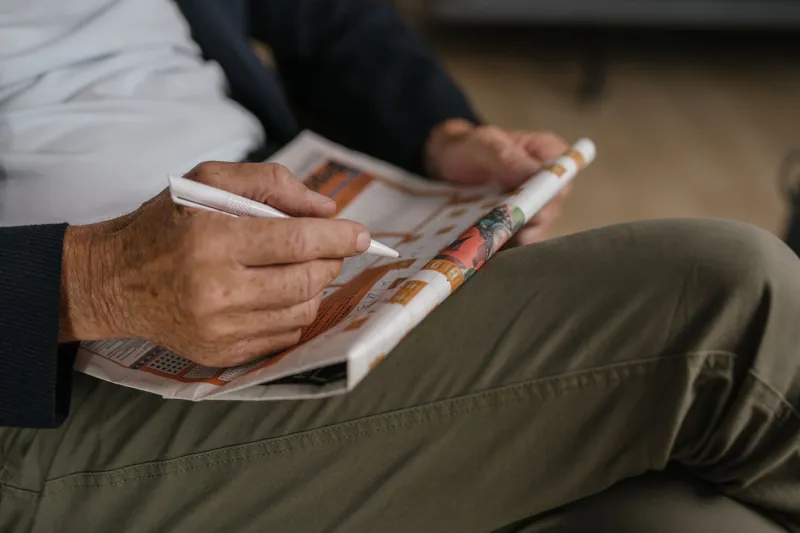
Every Sunday morning, somewhere in America, someone is hunched over a newspaper — or a phone, or a laptop — pencil in hand or thumbs hovering, staring at a grid of black and white squares with the quiet intensity of a person defusing a bomb. The crossword puzzle is as American as the Sunday paper itself. But the story of how it got there is less about inspiration and more about desperation.
The Problem With the Fun Section
In 1913, Arthur Wynne was the editor of the "Fun" section of the New York World, one of the city's most widely read newspapers. The World was a scrappy, populist publication that had made its name giving ordinary readers something to look forward to — comics, puzzles, games, stories. The Fun section was exactly what it sounded like: a few pages of light entertainment tucked into the Sunday edition.
But on December 21, 1913, Wynne had a problem. He had a gap on the page — a block of white space that needed to be filled before the edition went to print. He needed something new, something visual, something that didn't require a lot of explanation.
Wynne, who had grown up in Liverpool, England, remembered a word game from his childhood called a word square — a grid where the same words could be read both across and down. He took that basic concept, stretched it into a diamond shape, added numbered clues, and called it a "Word-Cross Puzzle."
It ran once, as filler, and Wynne moved on.
The Readers Did Not Move On
The response from New York World readers was immediate and enthusiastic in a way that clearly surprised the editorial team. Letters came in. People wanted more. The Word-Cross puzzle ran again the following week, and the week after that, and eventually every week. A few months later, a typesetting error accidentally switched the name to "Cross-Word" — and the new name stuck.
For the next decade, the crossword puzzle was essentially a New York World exclusive. Other papers occasionally ran similar puzzles, but no one treated them as a serious feature. That changed in 1924, when two young publishers named Richard Simon and Max Schuster — yes, those Simons and Schusters — launched their fledgling publishing house with a single product: a book of crossword puzzles.
Simon & Schuster almost didn't do it. The idea was considered beneath a serious publisher. They released it under a subsidiary name to protect their reputations. Each copy came with a pencil attached, because the editors weren't sure readers would know what to do with it.
The book sold out almost immediately. They printed more. Those sold out too.
America Catches the Fever
The crossword craze of the 1920s was, by any modern measure, completely unhinged. Newspapers that had previously ignored the puzzle format rushed to add crossword sections. Department stores sold crossword-themed merchandise. The Baltimore and Ohio Railroad added dictionaries to its dining cars so passengers could work puzzles during long journeys. Doctors began writing op-eds warning about the mental strain of excessive puzzling.
The New York Times — which would eventually become the gold standard of American crossword culture — initially refused to publish the puzzles at all. In 1924, the paper ran a piece dismissing crosswords as a "sinful waste" of time. It didn't add a crossword section until 1942, when wartime paper shortages forced the editors to reconsider what readers actually wanted during difficult times. The Times puzzle has run every day since.
Margaret Farrar, the first crossword editor at the Times, essentially invented the modern rules of the puzzle: symmetrical grids, no two-letter answers, no obscure abbreviations without fair crosses. She edited the Times crossword for 27 years and shaped the standards that every American puzzle editor still follows today.
What the Grid Actually Does to Your Brain
The staying power of the crossword puzzle isn't just cultural habit. There's real neuroscience behind why people keep coming back to it. Working through a crossword activates multiple cognitive systems simultaneously — memory retrieval, pattern recognition, language processing, and problem-solving. It's genuinely good for your brain in ways that passive entertainment isn't.
Researchers have found that regular crossword puzzlers show slower rates of cognitive decline as they age. The puzzle also creates a specific kind of satisfaction that's hard to replicate: the moment when a word you couldn't see suddenly snaps into place, unlocking three other answers you'd been stuck on. That small hit of accomplishment is, psychologically speaking, mildly addictive — and it's been keeping Americans coming back since 1913.
The crossword also quietly expanded American vocabulary. Puzzle constructors, constantly hunting for words that fit unusual letter combinations, reached into corners of the dictionary that most people never visited. Words like oreo, aloe, aria, and erne became crossword staples — familiar to puzzlers even if they'd never encountered them anywhere else.
From Newsprint to Algorithm
Today, the crossword puzzle exists in more formats than Wynne could have imagined. The New York Times crossword app has millions of subscribers. The Wordle phenomenon of 2022 — which swept the internet and briefly broke the Times website when the paper acquired it — is essentially a crossword puzzle stripped down to a single word. Mini crosswords, cryptic crosswords, themed crosswords, competitive crossword tournaments — the format has multiplied endlessly.
The American Crossword Puzzle Tournament, held annually since 1978, draws hundreds of competitors who solve puzzles at speeds that seem physically impossible. The current record for completing a Times Saturday puzzle — the hardest of the week — is under two minutes.
All of it traces back to a Liverpool-born editor staring at a blank patch of newsprint on a cold December afternoon, trying to fill a page before deadline.
Arthur Wynne didn't set out to create an American institution. He set out to get the Sunday paper finished. Sometimes that's exactly how the best things happen.