Too Cheap for the Carnival, Too Good to Ignore: How a Throwaway Toy Became America's First Babysitter
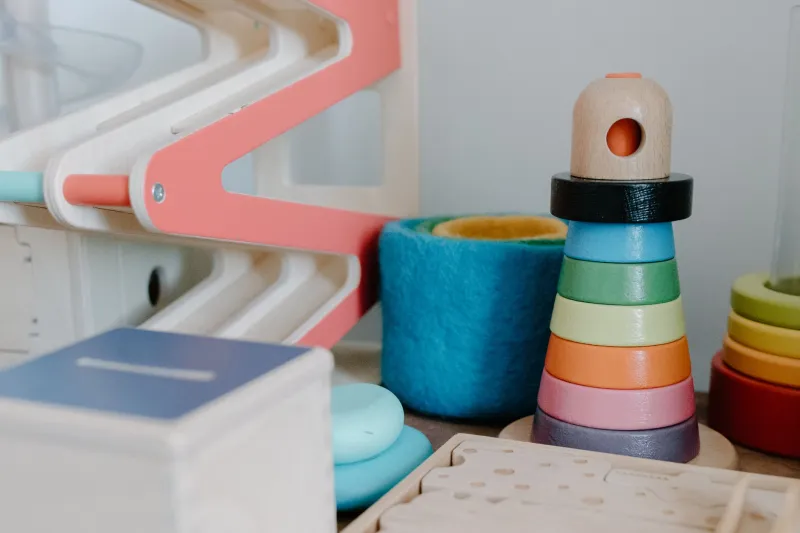
There are toys that announce themselves — loud, battery-powered, flashing things that demand your attention from across the room. And then there is the humble stacking ring toy: a wooden or plastic post, a base, and a handful of brightly colored rings graduated in size. No batteries. No instructions. No noise. It sits on the floor of every pediatrician's waiting room in America, worn smooth by a million small hands, and almost nobody has ever stopped to wonder where it came from.
The answer begins, improbably, at a traveling carnival somewhere in the industrial Northeast — and it involves a dismissive vendor, a postwar plastics boom, and one exhausted mother who accidentally stumbled onto something that child development experts are still talking about today.
The Carnival Vendor Who Passed
In the decades following World War I, American carnival midways were a reliable proving ground for cheap novelties. If a trinket could survive the chaos of a traveling fair — the heat, the rough handling, the demanding economics of a penny-a-pop game booth — it had a future. If it couldn't, it vanished.
Sometime in the 1920s, a simple stacking toy made of painted wooden rings began appearing at the fringes of these midways. The concept was old — versions of ring-stacking objects had existed in European nurseries since at least the mid-1800s — but American carnival vendors weren't impressed. The rings chipped too easily. The post wobbled. And more practically, it was hard to build a game around an object whose entire appeal was just putting things in order. Vendors passed. The toy drifted.
For roughly two decades, the stacking ring toy lived in a kind of commercial limbo: too simple for toy stores, too fragile for carnivals, too unfamiliar to attract serious manufacturing attention. It existed, but barely.
The Plastics Revolution Changes Everything
World War II reshaped American manufacturing in ways that took years to fully surface. One of the most consequential shifts was the explosion of consumer plastics. Factories that had spent the war years producing synthetic materials for military equipment pivoted hard toward domestic goods in the late 1940s, flooding the market with cheap, durable, brightly colored plastic objects.
Toy manufacturers were among the first to take advantage. Suddenly, objects that had been too fragile in wood could be molded in virtually indestructible plastic for fractions of a cent per unit. The stacking ring toy — previously dismissed for its tendency to chip and splinter — became an obvious candidate for reinvention.
A small Massachusetts toy company, working through a catalog of simple shapes that could be cheaply produced in the new materials, landed on the ring-and-post design sometime in the late 1940s. The rings were made large enough to be safe for very young children. The colors were saturated and distinct. The post was sturdy. It was, by any objective measure, an unremarkable product.
Then a mother left it on the floor.
The Accidental Discovery in a Massachusetts Kitchen
The story — documented in early toy industry trade notes and later recalled in interviews with the company's founding family — goes something like this: one of the company's principals brought a prototype home for her toddler to try. She set it on the kitchen floor, expecting to supervise. Something on the stove demanded her attention. She turned away.
When she looked back, her child had been quietly stacking and unstacking the rings for the better part of an hour. Alone. Without prompting. Without frustration.
This was, in the context of 1940s toddler management, something close to a miracle. The postwar American household was busy and often chaotic. Families were larger. Mothers were managing homes without the labor-saving devices that would arrive later. The idea that a single object could occupy a small child independently — and do so without danger — was not a small thing.
The company went into production. The toy was marketed initially through mail-order catalogs, then through the emerging postwar network of five-and-dime stores. Sales were modest but steady.
The Television Advertisement That Sealed It
What transformed the stacking ring toy from a minor catalog item into a generational fixture was a single television advertisement in the mid-1950s. Early children's television was still figuring out what it was, and toy companies were experimenting nervously with the medium. The ad that ran for the stacking rings was straightforward almost to the point of being boring: a toddler, a toy, a floor. The child stacked. The child unstacked. The child stacked again.
It ran during morning programming aimed at young mothers. It ran often. And it worked — not because it was clever, but because every parent watching recognized the scene. That quiet, absorbed, self-directed play was something every exhausted parent wanted more of.
Orders accelerated. The toy moved from catalog pages into dedicated toy store displays. Within a few years, it had become a standard shower gift for new parents, a pediatrician's office staple, and eventually a fixture in the waiting rooms of hospitals, dentists, and family doctors across the country.
From Waiting Room to the Smithsonian
By the 1970s, child development researchers had started paying serious attention to what the stacking ring toy was actually doing. Jean Piaget's theories about cognitive development in infants had entered mainstream parenting culture, and educators and pediatricians were newly interested in toys that supported what they called "object permanence" and early problem-solving.
 Photo: Jean Piaget, via static1.srcdn.com
The stacking ring toy checked nearly every box. It taught size differentiation. It rewarded sequencing. It built fine motor control. It offered immediate, satisfying feedback — the rings either fit or they didn't. And critically, it did all of this without adult direction. The child was the agent.
In 1998, a version of the classic stacking ring toy was added to the permanent collection of the Smithsonian's National Museum of American History, recognized not just as a commercial product but as a cultural artifact — one of the objects that had quietly shaped American childhood for half a century.
 Photo: Smithsonian's National Museum of American History, via vsfashion.bg
Why Experts Still Recommend It
In an era of tablets, educational apps, and screen-based learning tools marketed to children barely old enough to sit up, the stacking ring toy has not disappeared. Pediatricians and child development specialists still recommend it, often in the same breath as advice to limit screen time.
The reason is straightforward: it does something screens don't. It exists in three dimensions. It requires physical manipulation, spatial reasoning, and the tolerance of failure. A child who puts the largest ring on top and watches the tower collapse learns something no app can replicate — that the physical world has rules, and those rules don't change because you want them to.
A carnival vendor once looked at this toy and decided it wasn't worth the booth space. He wasn't entirely wrong about what it was. He was just completely wrong about what it could do.