The Jam-Proof Key That Rewired How the World Types Forever
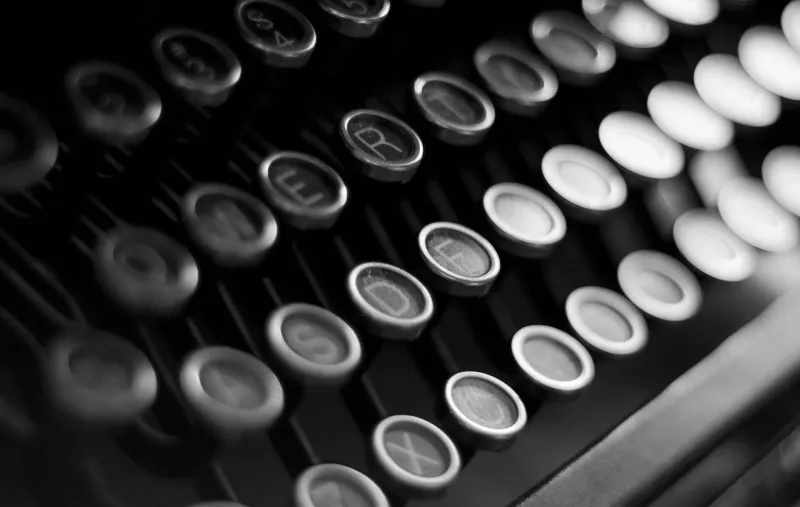
You've been typing your whole life. You've probably never once asked why the Q sits next to the W, or why the most-used letter in the English language—E—isn't anywhere near the center of your keyboard. The answer stretches back to a Milwaukee machine shop in 1873, and it has almost nothing to do with efficiency.
It has everything to do with keeping metal arms from crashing into each other.
The Machine That Jammed Constantly
Christopher Latham Sholes didn't set out to build the world's most influential piece of furniture. He was a newspaper editor and amateur inventor trying to solve a practical problem: early typewriters jammed. A lot.
The first commercial typewriters arranged keys in alphabetical order, which sounds logical until you realize that fast typists caused mechanical disaster. When two adjacent type bars were struck in quick succession, they'd collide mid-swing, locking up the machine and forcing the typist to stop and physically untangle the mechanism with their fingers.
Sholes, working alongside business partner Carlos Glidden and investor James Densmore, spent years tinkering with the key arrangement. Their solution was counterintuitive: scatter the most commonly paired letters far apart from each other on the keyboard so the corresponding type bars would have time to fall back into place before the next one swung up. The QWERTY layout wasn't designed to help you type faster. It was designed to help a machine type slower—or rather, to give a slow machine a fighting chance.
In 1873, Sholes licensed the design to Remington & Sons—yes, the same company that made firearms—and the first commercial QWERTY typewriter hit the market. By the 1880s, it was everywhere.
The Moment the Problem Disappeared
Here's where the story gets strange.
Within a few decades, typewriter engineering improved dramatically. Manufacturers solved the jamming problem through better mechanical design. The whole reason QWERTY existed had been eliminated. And yet nobody changed the keyboard.
By then, millions of typists had trained on QWERTY. Typing schools taught it. Businesses hired workers who knew it. Switching layouts would have meant retraining an entire workforce—a cost no company wanted to absorb. The layout had become what economists call a "path dependency": a solution so deeply embedded in infrastructure that changing it becomes more expensive than the inefficiency it creates.
In 1932, educational psychologist August Dvorak introduced an alternative layout specifically designed around how the English language actually works. He placed the most common letters on the home row, balanced typing load between both hands, and tested it rigorously. Studies—including some conducted by the U.S. Navy during World War II—suggested Dvorak typists could reach higher speeds with less effort. The Navy's own research reportedly showed that the cost of retraining typists would be recovered within ten days of improved productivity.
Nobody switched. QWERTY had already won.
How a Typewriter Layout Built the Modern Office Body
Fast-forward to the 1980s, when personal computers arrived in offices across America. Engineers faced a decision: what keyboard layout should these machines use? The answer, almost without discussion, was QWERTY. The layout transferred seamlessly from typewriter to terminal, from terminal to desktop, from desktop to laptop, and eventually to the glass touchscreen in your pocket.
What followed was an unintended public health experiment conducted on hundreds of millions of people.
Because QWERTY wasn't designed with human anatomy in mind, it places unusual strain on certain fingers and tendons. The layout favors the left hand despite most people being right-handed. It keeps frequently used keys off the home row, forcing constant finger travel. Ergonomics researchers began documenting a surge in repetitive strain injuries—carpal tunnel syndrome, tendinitis, and related conditions—that corresponded directly with the computer revolution of the 1980s and 1990s.
The American workplace responded not by questioning the keyboard, but by redesigning everything around it. Ergonomic chairs, wrist rests, split keyboards, adjustable desk heights, and standing desks all emerged as solutions to problems that a different key arrangement might have reduced from the start. An entire industry—worth billions today—exists largely because we inherited a layout from a machine that no longer exists.
The Alternatives That Never Stood a Chance
Dvorak isn't the only contender. The Colemak layout, introduced in 2006, was designed for modern typing patterns and promises faster learning curves for QWERTY users. Workman, NORMAN, and several other layouts have been developed, tested, and championed by devoted communities online. Some speed-typing champions swear by them.
And yet, as of today, QWERTY remains dominant across virtually every English-language keyboard on earth. The reason is simple and a little absurd: switching requires everyone to switch at once, and nobody wants to go first.
Operating systems now let you remap your keyboard in minutes. The barrier is no longer technical. It's psychological and social. We are all, collectively, waiting for someone else to move.
Why This Old Solution Still Matters
The QWERTY story isn't really about keyboards. It's about how solutions outlive their problems—and how the infrastructure we build around a temporary fix can shape human behavior for generations.
Every time you sit down at a desk, adjust your chair, position your wrists, and reach for a key that isn't quite where your hand wants it to be, you're participating in a design decision made in a Milwaukee workshop 150 years ago. A decision made not for you, not for speed, not for health—but to stop two pieces of metal from bumping into each other.
The machine that needed fixing is long gone. The keyboard it left behind is still running the world.