The Rejected Wartime Fabric That Accidentally Became America's Uniform of Freedom
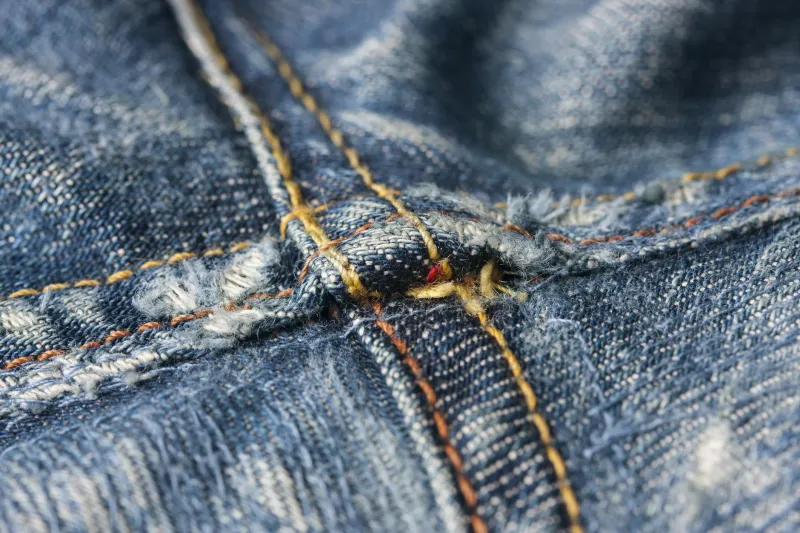
The Cloth That Polite Society Couldn't Kill
Walk into any American high school today and you'll see a sea of blue jeans. Yet less than seventy years ago, those same hallways would have sent you straight to the principal's office for wearing what educators called "the uniform of delinquents." The story of how denim went from mining camp necessity to global symbol of freedom is really the story of how American institutions accidentally created their own worst nightmare.
Gold Rush Pragmatism Meets Bavarian Innovation
The year was 1873 when Levi Strauss, a Bavarian immigrant running a dry goods business in San Francisco, received a letter that would change American culture forever. Jacob Davis, a Nevada tailor, had been reinforcing work pants with metal rivets at stress points—a simple solution to a practical problem. Miners kept ripping through their trousers, and Davis had figured out how to make pants that could survive the brutal conditions of the California Gold Rush.
 Photo: Levi Strauss, via www.sportandtravel.de
Strauss saw opportunity. Together, they patented the process and began manufacturing what they called "waist overalls" from a sturdy cotton fabric sourced from the Nîmes region of France—"de Nîmes," which eventually became "denim." The indigo-dyed material was cheap, durable, and perfect for men who spent their days crawling through mines and building railroads.
For decades, that's exactly where denim stayed: on the backs of laborers, farmers, and cowboys. It was utilitarian clothing for people who worked with their hands, as far removed from respectable fashion as overalls are from evening wear.
When Hollywood Made Work Clothes Dangerous
Everything changed in the 1950s when Hollywood discovered denim's symbolic power. Suddenly, Marlon Brando in "The Wild One" and James Dean in "Rebel Without a Cause" weren't just wearing jeans—they were weaponizing them. Denim became the visual shorthand for youth rebellion, sexual freedom, and rejection of middle-class values.
 Photo: James Dean, via ih1.redbubble.net
 Photo: Marlon Brando, via assets.catawiki.nl
American institutions panicked. Schools across the country banned jeans, claiming they promoted juvenile delinquency. The New York Board of Education declared denim "inappropriate for school wear." Movie theaters refused admission to jean-wearing patrons. Some restaurants posted signs reading "No Jeans Allowed."
The irony was perfect: the more respectable society tried to suppress denim, the more attractive it became to young Americans hungry for authentic self-expression.
The Counterculture's Accidental Uniform
By the 1960s, denim had evolved beyond simple rebellion. The counterculture movement adopted jeans as their unofficial uniform, but for different reasons than the 1950s rebels. Where previous generations had worn denim to shock their parents, hippies wore it to reject materialism and embrace authentic, unpretentious living.
This was denim's masterstroke: it could simultaneously represent working-class authenticity and middle-class rebellion. A fabric born from practical necessity had become a canvas for American identity politics.
The transformation accelerated when fashion designers began paying attention. In 1965, Yves Saint Laurent shocked Paris by putting denim in a high-fashion collection. American designers followed suit, and suddenly the same fabric that schools had banned was walking down runways in New York and Milan.
From Rebellion to Religion
The final transformation came in the 1970s and 80s when denim shed its rebellious associations and became simply... American. Everyone wore jeans: politicians campaigning for votes, celebrities at premieres, suburban mothers at PTA meetings. The fabric that had once terrified school administrators became so mainstream that its rebellious power was completely neutralized.
Today, Americans own an average of seven pairs of jeans each. We spend over $90 billion annually on denim products. The global jeans market, dominated by American brands, generates more than $200 billion in revenue yearly.
The Accidental Victory
Perhaps the most remarkable aspect of denim's story is how completely it won. The institutions that tried to suppress it—schools, churches, country clubs—eventually surrendered entirely. Many of those same schools that banned jeans in the 1950s now allow them as part of "casual Friday" dress codes for teachers.
Denim succeeded not despite institutional resistance, but because of it. Every ban, every prohibition, every moral panic only reinforced the fabric's association with authentic American values: individualism, practicality, and the right to make your own choices about how to present yourself to the world.
The rejected wartime fabric that nobody wanted became the uniform of freedom precisely because powerful people spent decades trying to make it disappear. In America, sometimes the best way to guarantee something's success is to tell people they can't have it.
Today, when you pull on a pair of jeans, you're not just getting dressed—you're participating in one of the most successful cultural rebellions in American history. A rebellion that won so completely, we've forgotten it was ever a fight at all.