Folded, Rinsed, and Saved: The Depression-Era Reflex That Still Lives in Your Kitchen Drawer
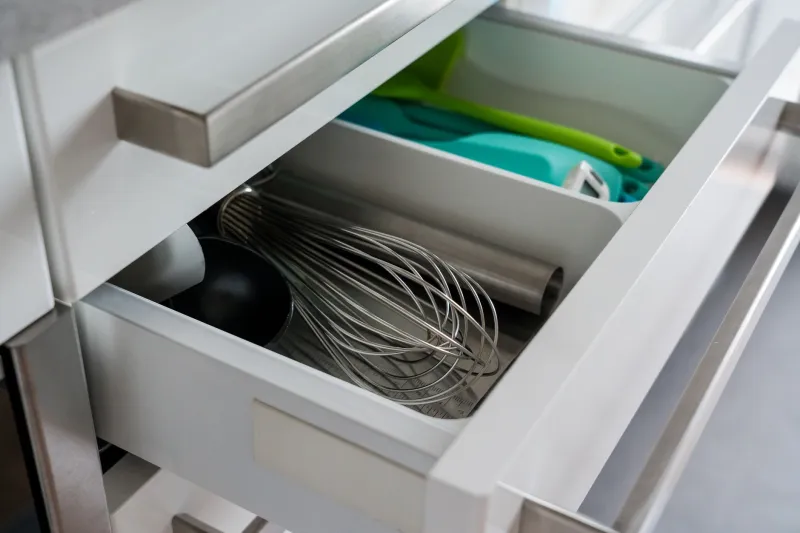
Open the right drawer in your grandmother's kitchen and you'll find it: a compressed mass of grocery bags folded into triangles, bread bag clips lined up along the edge, a ball of rubber bands the size of a baseball, and several sheets of aluminum foil so carefully smoothed and refolded they might as well be origami. She knows exactly what's in there. She doesn't consider it clutter.
You might laugh about it. But you probably have a version of it too.
This habit—the compulsive saving of things that most people consider disposable—didn't start with environmental consciousness or Marie Kondo in reverse. It started with hunger, and with the particular kind of fear that comes from not knowing where the next meal is coming from.
When Nothing Was Disposable
The Great Depression arrived in America in 1929 and didn't fully loosen its grip until World War II pulled the economy out of freefall a decade later. For millions of American families, those years meant genuine material scarcity. Not inconvenience—scarcity. The kind where you reuse wax paper because buying more isn't an option. Where rubber bands from the morning newspaper get saved because elastic costs money. Where a paper bag from the grocery store gets folded and stored because paper bags cost money too.
This wasn't a lifestyle choice. It was survival arithmetic.
Families developed systems. Lard tins became storage containers. Old newspapers became insulation. Worn-out clothing became quilts. Vegetable scraps became stock. The underlying principle was simple and absolute: if an object still has any possible use, throwing it away is a small act of self-destruction.
Then the war came, and the government formalized what Depression households had already been doing instinctively. Rationing programs administered by the Office of Price Administration put official limits on rubber, aluminum, tin, nylon, and dozens of other materials diverted to the war effort. The War Production Board ran public campaigns urging Americans to save cooking grease, flatten tin cans, and collect scrap metal. Waste became unpatriotic. Saving became a civic duty.
For a generation already trained by a decade of scarcity, wartime rationing didn't require much adjustment. They were already living this way.
The Habit That Survived Abundance
Here's what's remarkable: the material conditions that created these habits disappeared. The Depression ended. The war ended. The postwar American economy produced a consumer abundance that would have been unimaginable to a family standing in a breadline in 1932. Grocery stores filled with goods. Packaging became cheap and plentiful. Disposability became, paradoxically, a symbol of prosperity—if you could afford to throw something away, you were doing well.
And yet the habits persisted.
Psychologists who study intergenerational behavior have a framework for understanding why. Habits formed under conditions of extreme stress—particularly scarcity—don't simply dissolve when the conditions change. They get encoded. And more than that, they get transmitted. Not always consciously, not always through explicit instruction, but through the daily modeling of behavior that children absorb from the adults around them.
A child who grows up watching their mother rinse and fold plastic bags doesn't necessarily know why she does it. They just know that it's what you do. And when they have their own kitchen, they do it too. The behavior has detached from its original context and become simply part of how a household runs.
Researchers have documented this pattern across generations of families with Depression-era roots. The grandchildren and even great-grandchildren of people who lived through the 1930s show measurably different attitudes toward waste, saving, and material goods—even when those younger generations have never experienced financial hardship themselves.
The Plastic Bag Complication
There's an irony woven into the modern version of this story. The plastic bag—the most common object in the Depression-era-descended kitchen drawer—didn't exist during the Depression. Polyethylene bags didn't appear in American grocery stores until the 1970s and didn't become truly ubiquitous until the 1980s.
But the habit was already there, waiting for a new object to attach to. When plastic bags arrived, they slotted immediately into the behavioral framework that had been established with paper bags, wax paper, and cloth sacks decades earlier. The logic was identical: this is a container that still has use. You don't throw away something that still has use.
The same transfer happened with aluminum foil, which became a household staple in the 1950s. And with zip-lock bags in the 1970s. Each new disposable product got absorbed into a saving reflex that predated it by decades.
What Gets Passed Down Without Words
The most interesting thing about this habit isn't the bags themselves. It's what they represent about how culture actually travels through families.
We tend to think of inherited values as things that get spoken aloud—lessons taught, stories told, advice given. But a lot of what passes between generations is behavioral. It lives in gestures and routines and the small daily choices that nobody bothers to explain because they seem too obvious to explain.
The grandmother who rinses a plastic bag and hangs it over the faucet to dry is not thinking about the Depression. She's probably not thinking about anything in particular. She's just doing what you do. But encoded in that gesture is a memory of genuine want, a fear of waste that was once a matter of survival, and a relationship to material objects that the throwaway culture of postwar America never fully erased.
Her granddaughter, who grew up watching this and now keeps a drawer full of bags in her own apartment, may call herself environmentally conscious. She may frame the habit in entirely modern terms. But she's also, without knowing it, carrying something forward from 1932.
The Drawer as Archive
Next time you find yourself smoothing out a piece of foil instead of throwing it away, or tucking a rubber band into a drawer instead of tossing it in the trash, don't be too quick to call it irrational. You might be participating in something older than you realize.
That kitchen drawer full of saved things isn't clutter. It's a record. A compressed archive of a time when Americans learned, the hard way, that everything has value—and that the people who remember that tend to pass it on, even when they don't mean to.