Why Your Keyboard Was Designed to Slow You Down
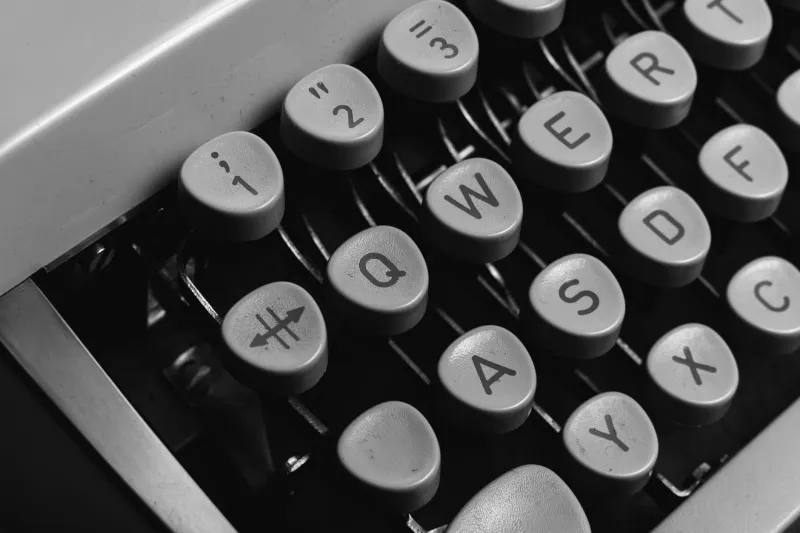
Look down at your keyboard for a second. Go ahead. Notice anything strange? The letters aren't in alphabetical order. They're not arranged by frequency of use. There's no obvious logic to where your fingers land. And yet billions of people around the world type on this exact layout every single day without ever questioning why.
The answer takes us back to a Milwaukee piano workshop, a frustrated inventor, and a mechanical flaw that permanently rewired the way humans communicate.
The Man Who Built the First Practical Typewriter
In 1868, a newspaper editor and amateur inventor named Christopher Latham Sholes filed a patent for what would become the first commercially viable typewriter. Sholes wasn't a tech visionary in the modern sense — he was a practical guy trying to solve a practical problem. Writing by hand was slow. Printing presses were massive and expensive. There had to be something in between.
Sholes partnered with Carlos Glidden and Samuel Soule, and together they built a clunky, piano-inspired machine that pressed inked letters onto paper. Early versions of the keyboard were arranged alphabetically — two rows, A through Z, clean and logical. It made perfect sense on paper.
In practice, it was a disaster.
The Jam That Changed Everything
The early typewriter worked using metal typebars — thin arms with letters on the end that swung upward to strike a ribbon and leave a mark on the page. The problem was mechanical: when a typist pressed two keys in rapid succession, especially keys that sat close together on the machine's internal framework, the typebars would collide mid-swing and jam together in a tangled mess.
This wasn't a minor inconvenience. It happened constantly. Typists would have to stop, manually separate the jammed bars, re-ink the ribbon, and start over. For anyone trying to use the machine professionally, it was infuriating.
Sholes spent years tinkering with the layout, studying which letter combinations appeared most frequently in English — TH, HE, IN, ER, AN — and then deliberately separating those pairs on the physical keyboard so their corresponding typebars would be far apart inside the machine. The goal wasn't to make typing faster. It was to make jamming less likely.
The result, after years of trial and error, was a layout that scattered common letter combinations across the keyboard in a way that looked completely random. Because for the machine's internal mechanics, random was better than logical.
That layout became QWERTY.
Enter the Piano Maker
Sholes eventually sold his patent to Remington — yes, the same company that made rifles and sewing machines — and in 1873, the Remington No. 1 typewriter hit the market with the QWERTY layout locked in. Remington's manufacturing facilities were already set up for precision mechanical work, and the company's experience building sewing machines meant they could produce typewriters at scale.
The piano connection runs deeper than most people realize. Early typewriter keys were literally modeled after piano keys — ivory-tipped, evenly spaced, designed for fingers trained on musical instruments. Sholes himself reportedly tested early prototypes with piano players because their finger dexterity made them the best available typists. The muscle memory of the keyboard and the muscle memory of the piano were, for a brief moment in history, the same thing.
By the 1880s, typing schools were opening across the country. The first generation of professional typists — mostly women, in a field that was just beginning to offer women office employment — learned QWERTY as their foundational skill. And once a generation of workers built their careers on a particular layout, changing it became nearly impossible.
The Faster Keyboard Nobody Uses
Here's where the story gets a little uncomfortable. In 1936, a professor named August Dvorak patented an entirely new keyboard layout based on actual research into how people type. He studied letter frequency, hand alternation, and finger reach. His layout put the most commonly used letters on the home row — the row your fingers rest on naturally — and distributed the workload more evenly between both hands.
Studies showed that the Dvorak layout reduced finger movement significantly and could be learned faster by new typists. The U.S. Navy ran tests during World War II and found that retraining typists on Dvorak paid for itself in improved efficiency within ten days.
Nobody switched.
By the time Dvorak's research was published, QWERTY was already everywhere. Typewriters, typing schools, office training programs, and an entire workforce had standardized around it. The cost of switching — retraining workers, replacing machines, reprinting manuals — was simply too high. The inferior layout had too much momentum.
When personal computers arrived in the 1970s and 80s, designers had a genuine opportunity to rethink the keyboard entirely. The mechanical jamming problem that created QWERTY didn't exist on digital machines. There was no technical reason to keep the old layout.
They kept it anyway.
The Invisible Architecture of Every Thought You Type
Today, QWERTY is so deeply embedded in American life that most people can't even imagine an alternative. Children learn it in school. It's on every phone. It's on every laptop. It's muscle memory for hundreds of millions of people who have never once stopped to ask why the Q is next to the W.
The hidden origin here isn't just about a keyboard. It's about how early design decisions — made under specific constraints that no longer exist — can lock entire civilizations into a particular way of doing things. The mechanical jam that Sholes was trying to prevent was solved long before any of us were born. But the solution he invented to prevent it is still shaping every email, every text message, and every search query you type today.
You're not using QWERTY because it's the best option. You're using it because a man in 1870s Milwaukee needed his typebars to stop crashing into each other.
And somehow, that's enough.